
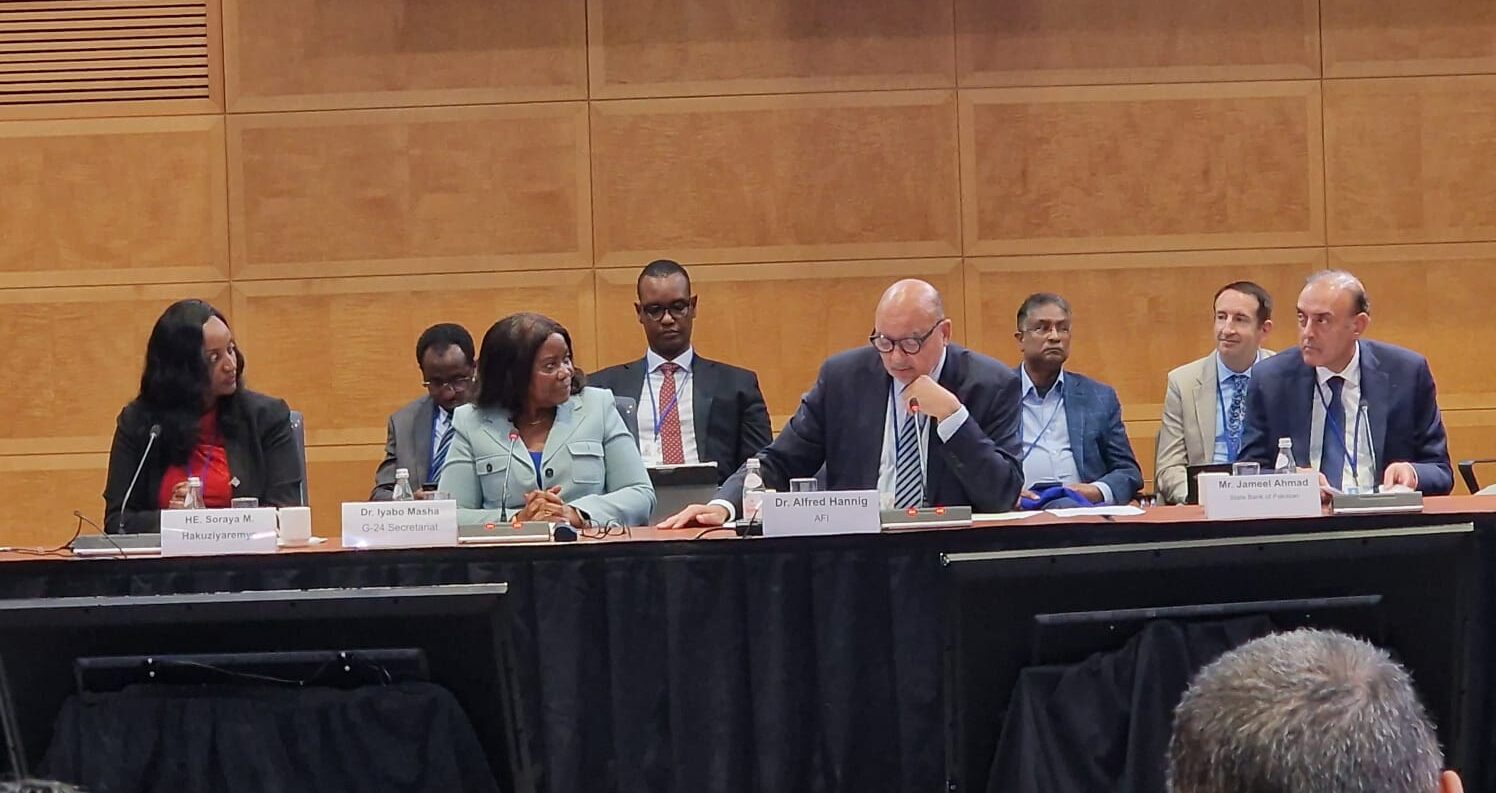
Findings from the first phase of AFI’s Complementarity Research Initiative, conducted in partnership with the University of Luxembourg, were presented at the 17th annual G-24/AFI Policymakers’ Roundtable in Washington D.C. on 14 October.
Professor Michael Halling, Chair in Sustainable Finance at the University of Luxembourg, shared findings which reveal significant positive effects of financial inclusion on key indicators of financial stability, as well as evidence that financial inclusion enhances financial institutions’ profitability and the efficiency of financial intermediation.
The findings were discussed by G-24 and AFI members and partners including AFI Chair and National Bank of Rwanda Governor, Soraya Hakuziyaremye, State Bank of Pakistan Governor, Jameel Ahmad, Central Bank of Sri Lanka Governor, Nandalal Weerasinghe, and Financial Action Task Force President, Elisa de Anda Madrazo,
Participants concurred that there is strong emerging evidence at both global and country level that responsible financial inclusion can reinforce financial stability as well as benefitting economic growth. To achieve complementarity, financial inclusion strategies need to be accompanied by effective policies to ensure the quality of inclusion, a focus on digital financial literacy, and high-quality supervision of emerging digital financial services. Vigilance against the proliferation of fraud and scams will also be key to maintain trust in the financial system.
Summarising the proceedings, Dr. Hannig highlighted that “this discussion came from a practical necessity to back up narrative with empirical evidence. With calls to refocus on core mandates and more recent geopolitical trends, there is an urgent need to protect the gains of financial inclusion.”
The next phase of the research, supported by IDRC Canada, will develop five deep-dive country case studies, as well as integrating the dimension of monetary policy effectiveness. Results are expected to be shared at the 2026 AFI Global Policy Forum in Papua New Guinea.