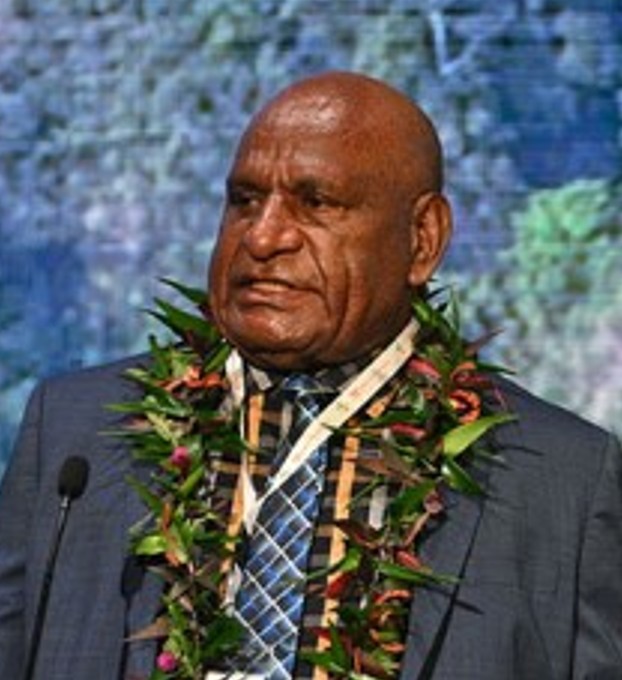
George Awap, Assistant Governor, Bank of Papua New Guinea
In Papua New Guinea, where climate impacts are very real and where 80% of the population are financially excluded, weather-related disasters pose a major risk to financial systems. That is why the Bank of Papua New Guinea (BPNG) is prioritizing Inclusive Green Finance as a way to facilitate the transition to a sustainable economy while building climate resilience among vulnerable groups.
Our green finance journey started in 2021. Following a new Central Bank Act, the Bank adopted green finance as one of our key strategic priorities. We established a steering committee and a technical working group who would collaborate to develop an Inclusive Green Finance (IGF) policy. The technical committee comprised about 35 stakeholders, including key government agencies, financial institutions, private sector actors and development partners. The steering committee is led by BPNG, the Department of Treasury, and the Climate Change and Development Authority, and includes strategic development partners including AFI.
Our IGF policy is evidence based, supported by a diagnostic report on the financial sector. It is accompanied by PNG’s Green Finance Roadmap and the region’s first Green Taxonomy. The Taxonomy is a classification system designed to allow investors, lenders, and other financial sector participants to measure the scope and volume of their inclusive and green financial flows. It can serve as a model for other Pacific Island nations, given the similarities of our economies.
In 2023, accompanying the Governor, the Prime Minister of Papua New Guinea officially launched our Inclusive Green Finance Policy. In March 2024, a Green Finance Centre within BPNG was introduced to implement the Policy, with support from our development partners, including the New Zealand Government, the French Development Bank (AFD) and Global Green Growth Institute, under the close guidance of AFI.
The Centre is supporting financial institutions to integrate the Green Taxonomy into their lending operations, and scale up sustainable lending to the private sector. It is also developing two financial instruments (Green Refinancing Facility and a Green Guarantee Facility), to further incentivize financial institutions to develop their green portfolio.
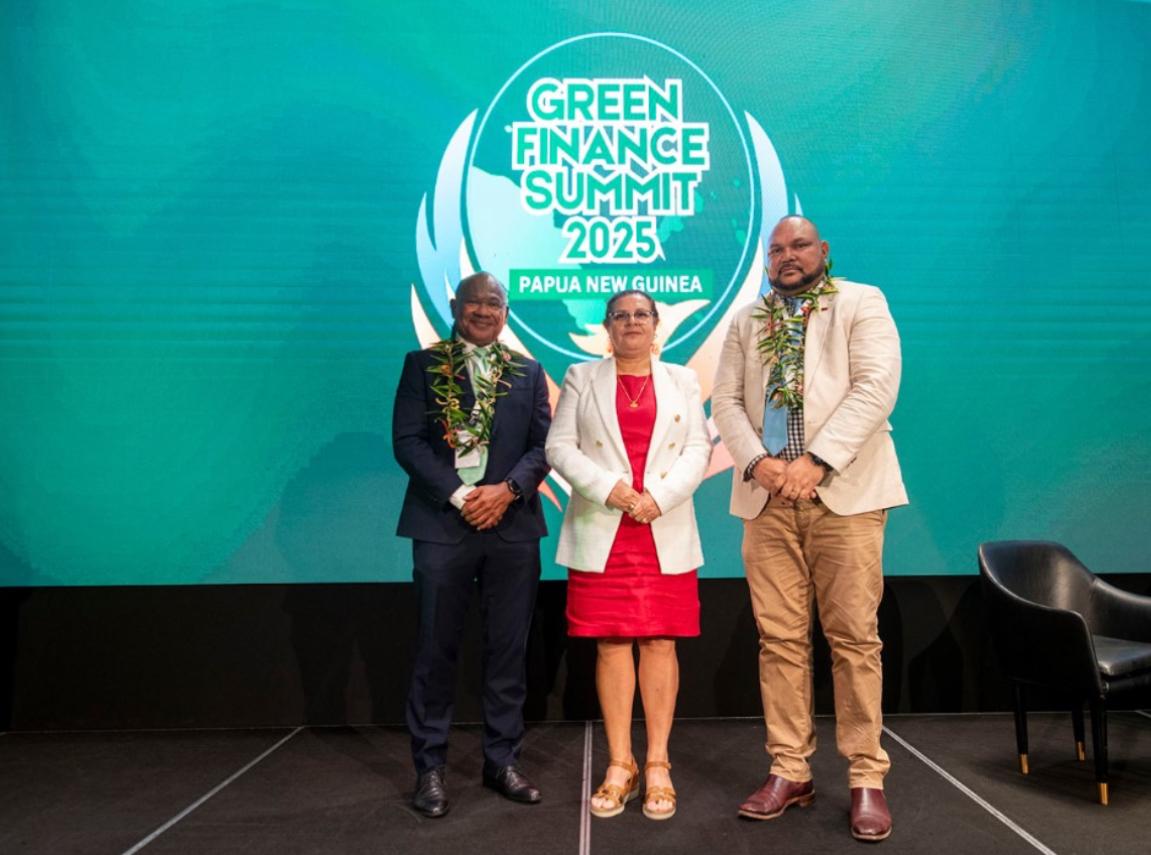
In March 2025, the Centre held a very successful Green Finance Summit in Port Moresby, bringing together all the key stakeholders – government, donors, developing agencies, investors, private sector, domestic actors, fellow central bankers from other Pacific Island nations, and international partners.
The Summit featured a climate finance roundtable, co-chaired between BPNG and IMF, that led to us establishing six workstreams.
The first workstream involves setting up a climate finance unit within our regulatory body, the Climate Change and Development Authority. In addition to operationalizing Green facilities which the Center is developing, we also have a biodiversity funds workstream, a forestry and carbon trading stream, a debt for nature swaps stream, and a renewable energy platform workstream. Through these workstreams, we hope to mobilize a billon dollars over the next two years.
The critical role of partners
Inclusive Green Finance is still a relatively new concept in the region. It requires extensive collaboration between the Bank of Papua New Guinea, financial institutions, government ministries, and domestic and international stakeholders.
Throughout our green finance journey, the Alliance for Financial Inclusion has been instrumental to our work. AFI plays a key role, not just in Papua New Guinea, but across the region in terms of helping to develop inclusive and sustainable finance policies.
Recently, the Governor of the Bank Papua New Guinea signed a cooperation agreement with the IFC and Sustainable Finance Network, which will greatly assist us in developing ESG guidelines, and from there, to develop the regulatory framework to report green lending in Papua New Guinea.
A key partner, not just for Papua New Guinea but across the South Pacific, is Agence Française de Développement (AFD), the French development agency. AFD has been strongly supportive of inclusive green finance, making available €6 million: €3.2 million to develop green finance in other South Pacific nations, and €2.8 million specifically for PNG. A lot of the good work which we are doing with the Global Green Growth Institute and with other partners is funded through the grant funds we receive from AFD – we are very grateful for their assistance in this area.