
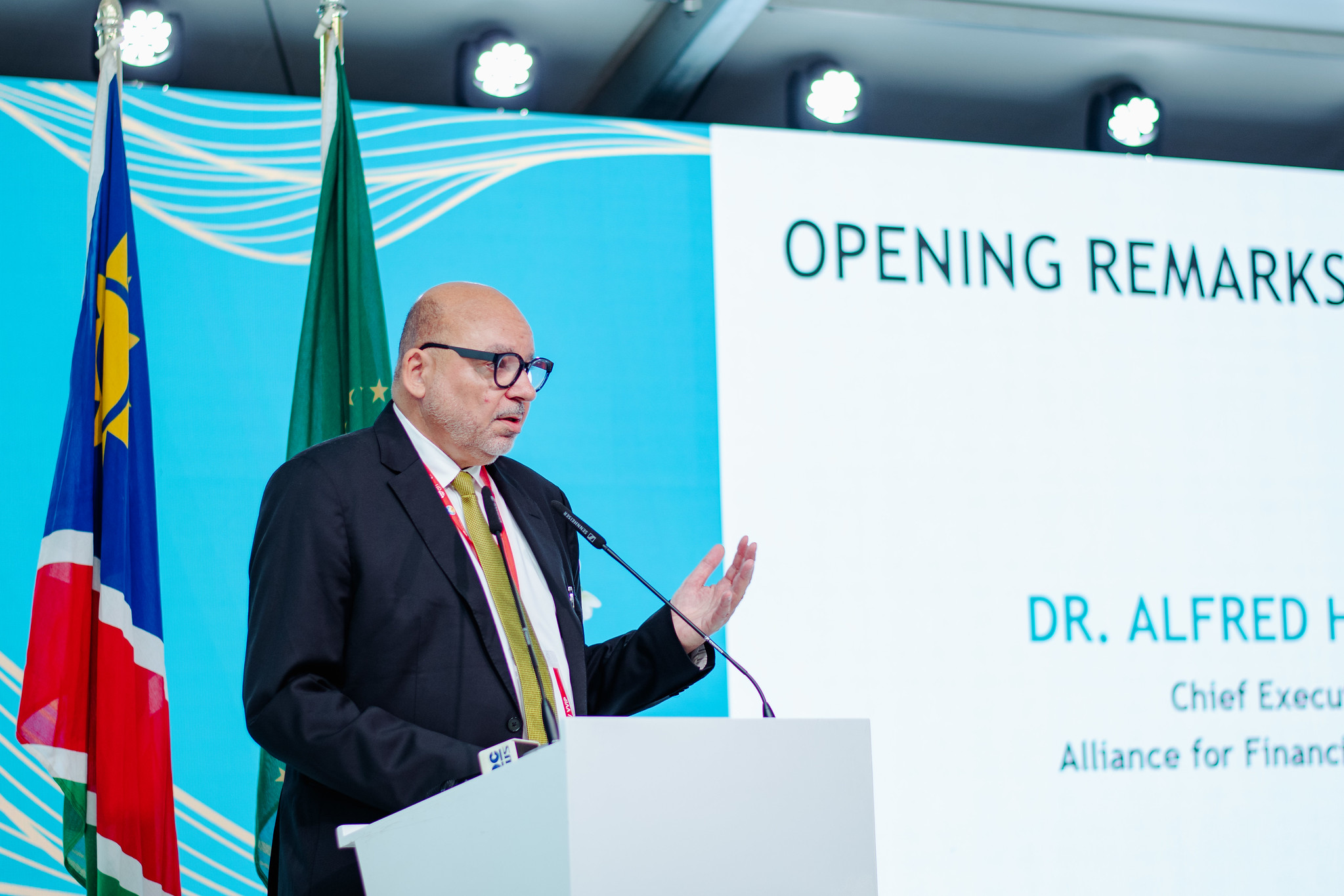
Let me start my remarks by emphasizing that we meet today at a time when there is great momentum in financial inclusion, globally. Data from the most recent Global Findex and AFI’s own sources reveal many examples of outstanding progress in the usage of financial services – a declining gender gap, increasing savings, thanks in large part to the rise in mobile money, and a recovery from the hardships of the pandemic. It is clear however that targeted policies and investment in infrastructure will remain vital. We need to keep strengthening regulatory frameworks, promoting digital IDs and supporting inclusive payment systems.
Particularly in Africa, there is good news. In sub-Saharan Africa, the share of adults with an account has grown from 24% in 2011 to 58% today. Among mobile money users, the gender gap has totally disappeared. Our host country, Namibia is an excellent example of progress on financial inclusion. The country’s achievements in instant payments, MSME financing, and regulating innovation are remarkable, and we are looking forward to learning about Namibia’s experiences and how these successes have been achieved.
I am sure that none of this progress on financial inclusion has happened by accident. These gains have been hard-earned.
But we still have a long way to go. While the global gender gap is narrower than ever, it still remains high, as high as 30% in some regions. 1.3 billion adults – 55% of them women – remain financially excluded. That remains a major challenges for us, and that is why Gender Inclusive Finance is the focus of the first panel discussion.
The global landscape has dramatically changed since 12 months ago, when we met in San Salvador.
Shifts in US trade policies are negatively affecting global trade, hitting developing economies hardest. Stricter migration policies are having serious economic repercussions on poor countries. Developed countries are shifting away from foreign assistance, and towards prioritizing national interests and defence budgets. There is growing scepticism towards the international development aid architecture. Last but not least, we are seeing an attack on values such as Diversity, Equity and Inclusivity.
While the US dominates the headlines, we see that in Europe too, aid budgets and contributions to UN agencies are downsizing. Undoubtedly, this will impact development cooperation. When budgets get slashed, aid workers laid off, and projects shuttered, the communities which depend on them suffer.
While it’s important to flag these consequences, we should not assume either that future administration changes might swing the pendulum back, or that the whole sustainable development agenda is now at risk. There must be a middle path. Human development will not stop, simply because a previous aid model is no longer in fashion.
Having listened to what AFI members think about this, I am more optimistic than pessimistic about what’s happening in the world. Over the last year I’ve spoken with many of you, including at the Washington DC World Bank Spring meetings and at our African Financial Inclusion Policy Initiative meeting in Accra, asking how current geopolitical developments are influencing your financial inclusion agenda. I want to share the answers I got, which should interest to all of you.
The AFI leaders I spoke to in fact unanimously emphasized that without financial inclusion, price and financial stability are at risk of being compromised. They were clear in saying that losing the emphasis on inclusion would be like shooting ourselves in the foot. There is no justification for us to change, even if some international organizations have changed their narrative. Many members pointed out that financial inclusion is critical for protecting the most vulnerable, and for providing safety in conflict situations.
My conclusion from these discussions is that for developing economies, financial inclusion has become a permanent macro-objective, because of its contribution to monetary and financial stability, but also because of its relevance for the SDGs.
These conversations confirmed my view that I expressed earlier this year, namely that AFI values are not negotiable – they are as permanent as the mandate of our members.
I have also been very encouraged to hear from a number of funders in the financial inclusion space that their efforts to support financial inclusion will continue, irrespective of the changing narrative around some international organizations.
The longstanding criticism on international aid boils down to three main points: lack of aid-efficiency, donor-driven but not country-owned, and failure to create impact.
When you consider these three, reflect on AFI. We are very aid-efficient, a point I emphasized at last year’s GPF in El Salvador. The AFI model is incredibly efficient. Our members’ commitment to pay fees complements donor funding, and increases the bang for the donor’s buck significantly.
Look around this room, and it’s clear that AFI has very strong country ownership. Our acctivity is driven by national agendas – it is not imported, or adopted from elsewhere.
As for the third point, that institutions that receive aid fail to produce impact, we have done a lot on this topic over the last year, and you will have seen the Impact Story videos that we are producing. Despiteg the attribution gap around policy, the fact that is not easy to show how policies relate to what is happening on the ground, we have started anecdotally to create stories that reveal what happens when a poor person gets access to even very simple financial services.
There is impact, and we can increasingly prove it. This last year, we had 104 policy changes in the Alfidata portal, whether Rachel studies, which is a 12 increase from 93, and we have also heard about the massive number of one billion that has been included as a result of RC activities.
Last year, AFI members logged 104 policy and regulatory changes in the AFI Data Portal during 2024 — a 12% increase from 2023. And we have also heard from Governor Soraya about the fact that one billion people have been financially included as a result of efforts made by the AFI network, since 2011.
This is significant, but not surprising. I know how much work our members have put into developing and implementing impactful policy reforms, into breaking down barriers, and into creating the conditions for innovation to thrive.
Those of us who work in financial inclusion everyday are aware of the inherent inertia between policy decisions and their actual outcomes and impact, which may only become visible after several years. It takes time for AFI to deliver results – but once delivered, the results are enormous. The example of a fully loaded ship that takes time to pick up speed, but once underway moves strongly, may illustrate what is meant by impact inertia.
Financially including one billion people has been possible thanks to openness – openness to cutting-edge solutions, openness to experimentation,
Two weeks ago, I attended a lecture from Professor Robert C. Merton, MIT Sloan School and Nobel Laureate in Economics 1997, at the Asia School of Business. Prof. Merton has studied how financial innovations emerged in advanced economies over several centuries. His main message was that history reveals that “best practice” does not equate to “best solution”, and that rather than asking what has been done, we should focus on what could be done.
This struck a chord with me. For over a decade, the financial regulators in the AFI network have been living up to this principle. Rather than replicating tried-and-tested, developed-world policies, they have asked – what could we do? And solutions that have produced impact have emerged. The research is clear: it pays to be open-minded.
Our funding partners recognize the value of AFI as an organization. Their investment in AFI is bringing about systemic changes in financial ecosystems for the long run, rather than placing band-aids on short-term issues. And that’s why we are well equipped with our cooperation model – it is strong, and has responses to the criticisms we have heard.