
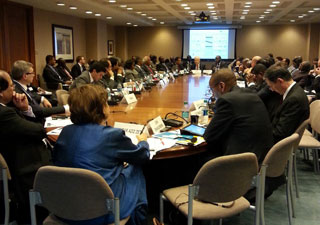
Members of AFI participated in several high-level meetings during the Spring Meetings of the IMF and World Bank Group in Washington, D.C. from 9-13 April 2014. Key among these meetings was the G24-AFI Policymakers’ Roundtable, which has quickly become one of the leading platforms for global engagement on the financial inclusion agenda.
Now in its sixth edition, the April meeting in Washington D.C. saw high-level members from more than 30 nations within the AFI Network gather for discussions under the overarching theme of “The AFI Peer Learning Initiative with Global Standard-Setting Bodies (SSBs)”. The theme built on discussions from previous years. Setting the stage for dialogue, Amar Bhattacharya, Director of the G24 Secretariat highlighted the AFI network’s belief in “the importance of proportionality in applying international standards to financial inclusion” while emphasizing “the lessons coming out of experience and practice in emerging economies.”
Participants were initially briefed on the considerable progress that has been made in shaping the initiative. Dr. Akhtar Aziz Zeti, Governor of Bank Negara Malaysia (BNM), highlighted a few key achievements, including: a strong mandate for AFI members to engage the SSBs during the Leaders’ Roundtable Meeting at the 2013 Global Policy Forum (GPF) in Kuala Lumpur; the establishment of a seven-member global standards sub-committee, which met for the first time at the Spring Meetings; and an invitation for AFI members to participate in an upcoming high-level meeting of the SSBs on financial inclusion co-hosted by Her Majesty Queen Máxima of the Netherlands, the United Nations Secretary General’s Special Advocate for Inclusive Finance for Development (UNSGSA).
While celebrating the progress made, AFI members recognized that sizeable challenges still remain – challenges that underscore the importance of moving the AFI peer learning initiative forward. “There are sometimes contradictions between the international standards and national public policy that need to be resolved by each country. The SSBs need to be aware of this when evaluating compliance and non-compliance with global standards,” said Maria Fernanda Trigo, Director General at Comisión Nacional Bancaria y de Valores (CNBV), representing CNBV Vice President and Chair of the new Global Standards Sub-Committee Bernardo González. Attendees also stressed the advantages for SSBs to take part in the peer learning initiative. “Like countries, the SSBs would benefit from each other’s perspectives and learning from each other,” said Nestor Espenilla Jr., Deputy Governor at Bangko Sentral ng Pilipinas (BSP).
Dr. Alfred Hannig, Executive Director at AFI, outlined the organizational structures established within the AFI Network to advance the peer learning initiative. These include a new sub-committee launched by the AFI Steering Committee to oversee peer learning on country practices with SSBs, expanding the Financial Integrity Working Group’s (FINTWG) mandate to provide technical support to the initiative, and AFI’s fruitful collaboration with global conveners such as H.M. Queen Máxima and the Global Partnership for Financial Inclusion (GPFI).
A pair of panel discussions highlighted critical elements of the work plan for peer learning with SSBs. The first panel discussion focused on country experiences of proportionality in practice. “This concept of proportionality is broadly accepted. But it is important to look beyond the concept and look case-by-case at the practical implementation. This will be the invaluable contribution of this AFI peer learning platform,” stated Deputy Governor Nestor Espenilla Jr.
Panelists concurred that proportionality becomes far more complex when examining practical applications. “The Basel standards are global standards, and the challenge is to adapt them for each country’s context,” said Atiur Rahman, Governor of Bangladesh Bank. “For developing countries the challenges are especially stark because we are dealing with inclusive initiatives that are generating new service delivery models, new client segments and new risks.”
However, participants heard several examples of how proportionate and tailored application of the global standards has contributed to dramatic increases in financial inclusion and poverty alleviation. Luiz Awazu Pereira da Silva, Deputy Governor at Banco Central do Brasil (BCB), illustrated how Brazil’s regulator had encouraged the creation of networks of agent banking and bank correspondents; now, more than 400,000 such agents disseminate financial services to almost every municipality and district. Meanwhile, Mexico has applied proportionality through its simplified account scheme, exempting bank accounts that are limited in balance and are, thus, low-risk from customer due diligence (CDD) requirements. John Rwangombwa, Governor of the National Bank of Rwanda (NBR), noted his nation has taken special measures for microfinance institutions to ensure the level of capital required is not prohibitive and has put special inspectors for MFIs in place at district level to guarantee consumer confidence. In Russia, the new payments sector is now instrumental in improving access as a result of proportionate regulation of the payments system, with new regulations introduced for electronic payments and agent banking. There are now 45 million mobile payment wallets operating in the country.
The second panel discussion focused on the risks of financial exclusion viewed from different country perspectives. At the 2013 G24-AFI Policymakers’ Roundtable, participants proposed the development of an extended risk framework that would take into account financial exclusion risks arising from the adoption of inflexible regulatory approaches. As session moderator Daniel Schydlowsky, Superintendent of Superintendencia de Banca, Seguros y AFP del Peru (SBS Peru) stated: “We now need to look at the other side of the picture, the consequences of exclusion… There are dangers of too much exclusion and these must be recognized.”
Panellists agreed that global standards, if not adequately taking financial inclusion issues into account, presented clear risks. Tiémoko Meyliet Koné, Governor of the Central Bank of West African States (BCEAO), pointed out that standards for national payments can worsen exclusion if they do not comply with developing country realities. The Mexican experience of tailoring global standards to avoid harmful consequences to the SME sector was also discussed. Participants wrapped up the second panel by discussing the role of peer learning in mitigating risks. “The only way the Caribbean could see more financial inclusion and mitigate the risk of financial exclusion is through greater collaboration among central banks,” said Jwala Rambarran, Governor of the Central Bank of Trinidad and Tobago (CBTT).
The roundtable concluded with AFI members agreeing on next steps for enhanced peer learning, which includes a work plan on case studies on proportionality in practice as well as the extended risk framework – both to serve as inputs for future engagement with the SSBs.
In addition, the Chair of the new Global Standards Sub-Committee, Mr. Bernardo González, Vice President of CNBV Mexico, and the AFI Management Unit will hold meetings with the secretariats of the Standard Setting Bodies this May in Basel. This will be followed by the meeting with the heads of the SSBs and H.M. Queen Máxima in October, at which AFI members will be represented.